LensWay-lenses-contactlenses


Buy contact lenses

» Home
» Contacts & Accessories
» Spectacles
» Ordertracking
» RefillExpress

Information

» FAQ
» Customer Support
» About LensWay

F.A.Q. - Frequently asked questions


Listed below are the most frequently asked questions. If you do not find the answer you are looking for please ring our freephone number 0800 328 11 22 from 09.00 - 19.00, Monday to Sunday with any questions you may have.

1. Policies & terms

Shipment
Over >95% of all orders are dispatched within 24hrs.

Please allow 2-3 days after dispatching for Royal Mail to deliver your order.

The expected date of delivery is indicated in the confirmation you receive after ordering.

The cost of shipment is of only 3.99 GBP flat.

An Express Delivery option can be chosen for all lenses in stock at 9,- £ extra More info…
Cost of shipment
At LensWay, the cost of shipping is 3.99 GBP/order flat.

Of course, we'll not charge you for backordered parcels sent separately.

An Express Delivery option can be chosen for all lenses in stock at 9,- £ extra More info…
Ordering outside the UK
No problem. We deliver virtually everywhere: Just go to www.lensway.com and choose the country from which you wish to order.
Secure Shopping
None of your payment detail is being transmitted to /saved by LensWay since all payments take place directly on the creditcard-suppliers' securely encrypted interfaces alt. PayPal's independendent platform. A loss or abuse of your data is thus virtually impossible.
Payment
We accept all major credit cards, PayPal, Maestro, Visa Electron and Solo. Just select your preferred option when checking out.
Returns
You may return complete, unopened and unmarked contactlens boxes without questions asked - LensWay will refund the entire amount: glasses may be returned within 3 month and contact lenses within 14 days from delivery.

If you wish to return goods it is mandatory to contact our customer support for further instructions.
Confidentiality
LensWay adheres strictly to the Personal Information Act. According to this Act, you must give your consent for us to process and save details about you in our database. By purchasing your contact lenses from LensWay, you acknowledge this consent. All personal details, including your birth date, which you give us or of which we are made aware when you register as a purchaser or visit our home page, will be processed by LensWay in its capacity as the party responsible for personal details. The information will be used to enable us, in conjunction with purchases, to discharge our obligations to you, to conduct credit checks and for marketing purposes. LensWay will never permit a third party to use your personal details for marketing purposes. You have the right, on request, to see the personal details about you that are registered. If they are incorrect, incomplete or irrelevant, you have the right to request that the details be corrected or deleted.
Cookies
What is a cookie?
We use cookies on our Web site. A cookie is a small text file that is stored on your computer and contains information. Cookies can be divided technically into two types. One type saves a file permanently on your computer. Cookies of this type are used to produce a "one-off performance", for example if we want to inform you about something once, and avoid showing you this information again the next time you visit our Web site. The other type of cookies are called session cookies. Whenever you visit our web site, this cookie will be sent between your computer and the server to enable us to link to information, for example the language that you have selected. Session cookies are not stored permanently on your computer, they disappear when you close your browser.

Purpose of cookies.
All cookies used on LensWay's home page, regardless of their type, are used to simplify your experience as a user, and not to store information, to record your behaviour or for any other purpose that could threaten your integrity or security. For example, we may store information on your computer via a cookie (type 1) for settings that you have entered with us in order to personalize and simplify your usage of our site. It is also worth noting that the storage of information via cookies means that it is not stored at LensWay, unless this has been expressly stated or approved.

If you turn off your cookies.
Apart from the reason given above for session cookies (type 2), these are also required to enable us to provide a coherent, safe and fault-tolerant web site with the opportunity for personalization and logging-in, instead of just a number of loosely connected pages. If you turn off your cookies, we cannot guarantee that our services will function and it will not be possible to log in on the LensWay site. In order to prevent cookies, you can turn them off in the settings of your Web browser. Go to the respective browser supplier's home page for instructions about how to turn off cookies.
Terms and conditions
We always send our consignments by Royal Mail's First Class services. You can find the estimated date of delivery for your specific order by clicking the "Date of delivery" button before ordering and on the order confirmation that you will receive by e-mail.

With >95% of all orders being sent out within 24hrs. an average delivery will take 2-3 days. For certain very rare products/parameters please allow more time.

You may return unopened and unmarked items within 14 days of delivery (contact lenses) and within 3 months (glasses). Always contact our customer services before returning goods.

2. Lensway

How come LensWay can offer better prices than my optician?
LensWay handles far greater volumes of contact lenses than your local optician.

Large volumes
Most opticians only care a limited selection of contact lenses. In order for them to be able to obtain a volume discount from their distributors they have to save up their orders for a few days or weeks before sending them in. It is likely; therefore, that the delivery times are slightly longer than the one you get with LensWay. At LensWay we do not wait for you to order the lenses, we already have them in stock. These lenses are purchased in larger volumes and thus we can reduce the price.

Low costs
Opticians have a high margin on their products due to the cost of rent, staff and store. We have low costs because we do not have any stores.

Efficiency
We have Europe's largest contact lens inventory and most often have all major brands in stock. LensWay has also begun to offer a large assortment of glasses. Our glasses department use the fastest and most modern machines which can produce more than 500 pairs of glasses per day. Prices for both contact lenses and glasses are lower since we have the opportunity to purchase large quantities and use an effective supply chain.
How much can I save by choosing LensWay?
How much you save depends entirely on what lens you wear and on where you buy your lenses today. We always keep our prices as low as possible. You will also save a lot of time by choosing LensWay.
Can I be sure that I will receive original products when I order from LensWay?
Yes, we only sell original products from well known manufacturers. European law constitutes that medical products, such as contact lenses, must always be identical, regardless of who you buy it from. This means that you can be certain that the contact lenses that you receive from LensWay will always are identical to those that you receive from your optician - and that the service will be cheaper, faster and simpler.
Why should I order my contact lenses from LensWay?
LensWay always offers the most convenient way to obtain contact lenses. We have the fastest deliveries on the market, great prices and an award-winning customer support.

3. Contact lens parameters

What does diameter mean?
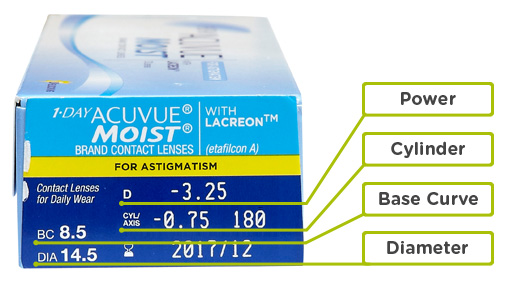
The diameter (often abbreviated to DIA) is the size of the lens measured from edge to edge.
What does cylinder mean?
Cylinder (often abbreviated to CYL) is one of the values or measurements used to describe toric lenses. Toric lenses are used to correct astigmatism, a condition marked by unevenness of the cornea.
What does base curve, BC or radius mean?
The base curve or radius (often abbreviated to BC) describes the curvature of the lens.
What does axis mean?
An axis (often abbreviated to AX) is one of the values or measurements used to describe toric lenses. Toric lenses are used to correct astigmatism, a condition marked by unevenness of the cornea.
What does extra strength or add mean?
Add power describes the difference in strength between the focal fields in multifocal and bifocal lenses.
Where can I find my parameters?
You can find your parameters on the paper copy of your prescription, or on the box containing your lenses. You will find details of the power/strength/sphere (SPH), base curve (BC) and diameter (DIA). If you have astigmatism you will also find an axis (AX or AXIS) and cylinder (CYL). If you use bifocal, multifocal or progressive lenses, you will find the extra strength or "add power". The brand name you were prescribed will also be described. If in doubt, please contact us.

4. Glasses

Where are the glasses produced?
Your glasses are made in our grinding workshop at our head office in Stockholm. Using our modern machines, we’re able to grind 500 pairs of glasses per day! We select the glass that’s best suited to your specific visual defect and maintain exactly the same standard that you’d find at an optician.
What is included in the price?
We have a simple pricing model. You order glasses with complete single-vision lenses for £33,33, £66,66 or £99,99 – not more, not less. All the prices you see include the frames, thin and lightweight lenses, hard coating and Anti-reflective treatment and accessories (case, tool- and cleaning kit). We select the glass that's best for your visual impairment. If you use progressive lenses, add £99,99 to the above stated prices. A postage charge of £3,50 is added.
Our glass, frames and choices
Glass type and strength
You’ll find we have a large selection of attractive frames. Once you’ve chosen your frames, we’ll make sure you get the lenses best suited to your visual impairment. Irrespective of price class, the price of the frames includes single vision lenses of the same high quality you’ll find at the optician.

Progressive lenses
Progressive lenses correct age-related long-sightedness (presbyopia). The upper part of the glass contains strengths for distance. The lower has strengths for reading distance. In between, the strength changes gradually between distance strength and close-up strength. If you order progressive lenses, £99,99 will be added to the stated prices.br>
Anti-reflective treatment, Hard coating and Water-repellent coating
Our glass is treated to be anti-reflective, hard and water-repellent.

Anti-reflective treatment removes irritating reflections, thus allowing more light into the eye and providing you with more visual comfort. The treatment also allows others to see your eyes more clearly through the lenses and for you to see better, for example when using a computer or driving in the dark. The hard coating is applied in the form of a thin protective layer on the lens surface. This makes the glass more resistant to scratches and prolongs the lifetime of your glasses. The water repellent treatment makes lenses resistant to dirt and liquids. br>
Other options
We make the glasses you want. Feel free to contact our Customer Services with any wishes you may have regarding glass and treatment beyond the types shown above and we will help you.
Types of glasses
The most common types of glasses are distance glasses and progressive glasses:

Distance glasses
These correct your vision so you can see well at a distance. Distance glasses correct short-sightedness (minus powers), long-sightedness (plus powers), and refractive errors (astigmatism).

Progressive glasses
These correct age-related long-sightedness (presbyopia). The upper part of the glass contains strengths for distance and the lower for reading distance. In between, the strength changes gradually between distance strength and close-up strength.

We make the glasses you want. Feel free to contact our Customer Services with any wishes you may have regarding the above and we will help you.
Does the prescription have to be sent in before ordering from LensWay?
When you order your lenses from LensWay, you must have a valid contact lens prescription from an optician. You do not need to send in your prescription.

When you order glasses, you need a valid prescription from an optician. You can enter these values directly into our website when ordering.
Satisfaction guarantee
If you’re not satisfied with your glasses, feel free to contact our Customer Services and we’ll help you. You’ll always have a two-year product warranty when you shop at LensWay. You’re also entitled to your money back if you return your glasses within three months.
Eyeglass Prescriptions
To order glasses from LensWay, you’ll need a valid prescription from your optician (no older than one year). You’re entitled to a copy of your prescription according to legislation on patient records. When placing your order, send us your values (or you can send us the prescription instead).
How to order glasses
Here’s how you order glasses: 1. Choose your frame. 2. Fill in the strength and the values stated on your prescription. 3. Pay by your preferred payment method (the purchase price is debited to your account at the time of purchase).

Ordering glasses directly is the quickest way to obtain new glasses – they’re normally delivered within just a few days. When ordering progressive glasses or extremely high/low strengths, delivery time may be somewhat longer.
Eye examination for those who wear glasses
We recommend that you visit an optician for an examination at least once a year. By checking your visual impairment, measuring your pupillary distance and examining how your eyes move and work together, your optician will help you decide on the type of visual correction you need. Once you’ve had your eyes examined, you’ll receive a prescription for your glasses, showing all of the necessary values and parameters.
How much do progressive glasses cost?
You can order progressive lenses for most of our frames. When you order progressive lenses, add £99,99 to the stated price. The stated price includes the frames, lenses, hard coating and anti-reflective treatment and accessories (carrying case, polishing cloth and screwdriver).
If there is no pupillary distance in your prescription
If pupillary distance is not shown on your prescription, you can easily measure it yourself. Proceed as follows:
1. Ask another person for help
2. Place a ruler below your eyes and look straight ahead
3. Let the other person measure the distance in millimetres between your pupils and divide by two
4. Preferably repeat several times to make sure the measurement is correct.
Visual impairments
Visual impairments are common. In most cases they can be easily corrected with lenses or glasses. There are four basic types of visual impairment:

1) Long-sightedness (hyperopia) - vision is poorer at close range (glass has positive strength).
2) Short-sightedness (myopia) - vision is poorer at longer range (glass has negative strength).
3) Astigmatism (refractive error) - vision is not sharp, since the points of refraction of the light focus at different angles (lenses have cylinders and axes). This visual impairment is usually combined with either long-sightedness or short-sightedness.
4) Age-related long-sightedness (presbyopia) - poorer vision at close range and difficulty reading small print, because the eye finds it more difficult to adjust (glass has extra strength/addition).
How can you sell glasses so cheaply?
At LensWay, during the last 10 years we’ve been able to work with our customers to effectively reduce our contact lens prices; now we want to achieve the same with glasses. You can save a lot of money when buying glasses. In fact, you can save hundreds of Pounds by buying your glasses online without any reduction in quality. The reason we can sell much more cheaply than an optician is huge order-volumes, no expensive highstreet shops, no middlemen, in-house manufacturing and efficient logistics.
How to fill in strengths and pupillary distance
Your glasses prescription has all the information you need to order glasses. If you don’t have your prescription, you can request it from your optician. You are entitled to it under patient records legislation. . Depending on your vision problem, you’ll find combinations of the values below. Remember to indicate values for both the right eye (OD) and left eye (OS).

Power/sphere
Minus values indicate that you’re short-sighted and plus values that you’re long-sighted.

Cyl/Cylinder
The first value for correcting refractive errors (astigmatism) shows how great your refractive error is.

Ax/Axis/Axel
The second value for correcting refractive errors (astigmatism) is indicated in degrees and shows where in your eye the refractive error occurs.

Pupillary distance/PD
This indicates the distance between your pupils in millimetres. The pre-printed value (32) is a standard value that usually works well for everyone. If the pupillary distance is indicated by only one value on your prescription (e.g. 60), divide this value by 2. Thus, PD 60 should be indicated as PD 30 (left eye) and PD 30 (right eye).

Addition/ADD
The value for correcting age-related long-sightedness (presbyopia) used for progressive lenses.

5. Brands & types

How do progressive and bifocal lenses work?
The most common progressive lenses have a gradually stronger power towards the centre. This enables clear vision at both long and short distances, so-called simultaneous vision. Bifocal lenses also provide simultaneous vision. They have different zones in the central part of the lens for vision at long and short distances.
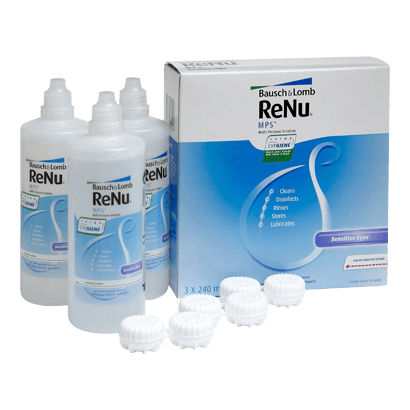
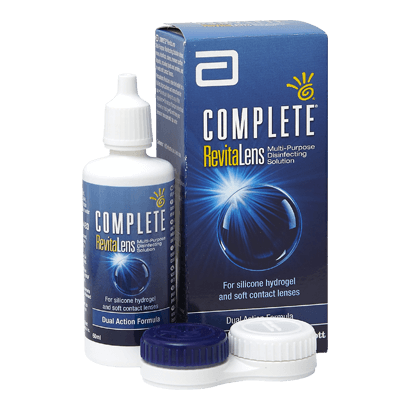
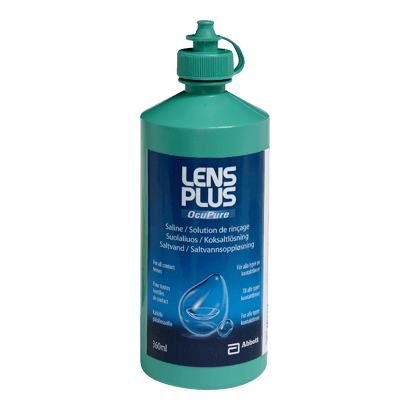
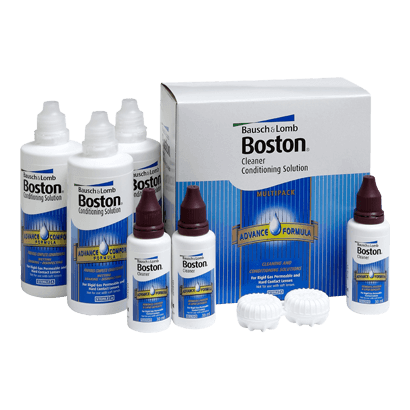
Which lens solution is best for my lenses?
We recommend that you follow your prescription, which also covers the choice of lens fluid.

The lens fluids in our range are suitable for all soft contact lenses and can be used for both washing and cleaning the lenses.

Certain chains of opticians sell lens fluid under their own brands. If you cannot find the fluid that you are using today, contact our customer services so that we can tell you the fluid to which it corresponds.

You can read more about lens fluids on the appropriate product information page.
Which coloured lenses will work for me?
The type of coloured lenses you should wear depends on your natural eye colour and the result you desire. People with naturally light eyes get the best results by using a lens that enhances their natural eye colour. People with naturally dark eyes get the best results by using opaque coloured lenses, so that their natural colour doesn't show through and overpower the new colour. For optimal results, consult an optician. If you need prescription lenses, you will need to obtain a new prescription before you can order coloured lenses.
Is Acuvue a monthly lens or a 2-week lens?
Acuvue can be prescribed either as a 2-week lens or as a monthly lens. Always follow your optician's instructions and replacement schedule.
Why should I wear extended wear contact lenses?
When using extended wear lenses you do not have to remove, clean or handle your lenses every day. Since the material in extended wear lenses admits extra oxygen to the eye (cornea) you can keep them in your eyes for longer time periods. If you wish to change to extended wear contacts you must consult a qualified eye care practitioner.
What are toric lenses?
Toric lenses correct a type of diffraction error known as astigmatism.
Why are toric lenses with colour not available?
Coloured toric lenses are available (although not in LensWay's range), but they are not very common. Since the demand is not very high most contact lens manufacturers have concluded that it is too expensive to produce coloured toric lenses.
What is the difference between Purevision and Air Optix Night & Day Aqua?
Both PureVision and Air Optix Night & Day Aqua are so-called silicon hydrogel lenses and are approved for wearing while sleeping for up to 30 days, although they are manufactured from different materials. Air Optix Night & Day Aqua lets far more oxygen through and has lower moisture content. Air Optix Night & Day Aqua has a smaller diameter and 2 base curves (radii), while PureVision only has one single base curve. The surface treatments on the lenses are also different. You cannot simply switch between these lenses, and they must be tried out individually. Several other lenses are approved for wearing while sleeping, although most for only up to 6 nights. The majority of opticians now only recommend silicon hydrogel lenses for all-day use, because they are so much safer than older types of all-day lenses.

6. Eye exams & prescriptions

Will I still need to go for check-ups at my optician's?
Yes. Since your eyes are constantly changing we recommend that you have your eyes examined by a qualified eye care practitioner at least once a year.
Do I need to send in my prescription to purchase from LensWay?
To order from LensWay you must have a contact lens prescription from an optician, but you do not need to send anything to us. You simply confirm that you have a prescription when you order your lenses.
What is the difference between an eyesight test for a contact lens wearer and a spectacle wearer?
When examining the eyes of a contact lens wearer, the optician will examine the eyes with a so-called split lamp and make sure that the power of the lenses is correct. The optician will verify that there are no signs of side-effects such as lack of oxygen, chafing, irritated eyelids, excessive reddening of the eyes or vascular invasion. The optician will also look for signs of eye disease such as cataracts and glaucoma, etc. Various side-effects of contact lenses are quite common. It is important that these are discovered in time so that the fit can be changed as required and the customer can be given advice to avoid that the problem develops into a serious condition. Contact lens wearers tend to handle their lenses carefully initially, but often become less conscientious after some time. The eye examination provides a good opportunity to update your handling procedures. Contact lens technology is developing rapidly, your optician can keep you up to date if a new innovation that suits your particular needs appears on the market.
What can happen if I order lenses for which I do not have a prescription?
You must never take the risk of ordering a lens that has not been prescribed for you. It may cause irreparable harm to your eyes, but the most likely outcome is that the lens will not feel at all right and that you simply will not be able to wear it. (See LensWay's terms and conditions of purchase). When purchasing from LensWay you confirm that you have been prescribed the contact lenses you order by a qualified eye care practitioner, therefore we do not take responsibility if you order a lens that has not been prescribed for you.
Why is it important to have an eyesight test every year?
Your eyes are constantly changing which means that your contact lens parameters may need to be altered. Your optician will also ensure that your eyes are still healthy.
Is it possible to have an eye examination for contact lenses or an eyesight test at an optician's without purchasing lenses?
Yes. You choose when you want to buy contact lenses. You can always have an examination at your optician and obtain a copy of your records, where all prescriptions and parameters must be noted. Then you can purchase your contact lenses from LensWay.

7. Using contact lenses

My eyes become irritated when I wear contact lenses. What should I do?
First check that you are wearing lenses that conform to your prescription, and that the lenses are not defective. Contact our customer services if you have any questions. If you have problems, stop wearing the lenses and consult your optician.
Can a lens be harmful in any way if it feels good to wear (though it has not been prescribed for me)?
You must never take the risk of ordering a lens that has not been prescribed for you. It may cause irreparable harm to your eyes, but the most likely outcome is that the lens will not feel at all right and that you simply will not be able to wear it. (See LensWay's terms and conditions of purchase). A contact lens can harm your eyes even if it feels good.
Which bacteria, fungi and amoebae colonize lenses, and what can they do?
Many different microorganisms are capable of producing side-effects in conjunction with contact lenses. The most serious side-effect is infection in the cornea. If bacteria are present on the lens, this need not mean that you will get an infection, although the risk will increase. Bacteria on the lenses can also cause inflammation in the eye. That is why it is always important to ensure good hygiene and to follow the cleaning and disinfection instructions closely. With the fewest possible bacteria on the lenses and in the storage case, the risks of infections and inflammations will reduce.

The Pseudomonas bacterium, for example, is capable of producing severe infections, which in the worst case can lead to serious visual impairment. Fungi (e.g. Candida) rarely cause infections in the cornea, unless the individual is already in a poor general state of health or has an immune system deficiency. However, they can grow on the lens and destroy it. Mould fungus also occurs when the lenses have been left standing too long in a fluid without preservative. The most feared and treatment-resistant infection is caused by Acanthamoeba. This is a single-celled organism that occurs naturally in the soil, water, etc. It is a very rare infection, but it is highly resistant to treatment and almost always leads to visual impairment or even blindness.
If I have dry and sensitive eyes, what type of lens will my optician try?
There can be many reasons for dry eyes, and you will often need to try out different types to find a good solution. Sometimes changing your contact lens solution or changing to a contact lens with lower fluid content can help. The lenses that usually work best for dry eyes are the new silicon hydrogel lenses, for example Focus Night & Day or PureVision.
What are the risks if you wear a monthly lens for longer than a month, or a daily lens for longer than a day?
Wearing contact lenses for a longer time period than the intended is not to recommend. The period of use is set to ensure that the majority of users will not notice any significant deterioration in comfort or visual acuity. When contact lenses are worn for a longer period than the recommended the health risks increase. The biggest advantage with daily lenses is that you do not have to clean them. If you start wearing them more than once they must be cleaned and disinfected. Without proper cleaning they can harm your eyes.
For how many hours can I wear my contact lenses without taking them out?
How long you can wear your contacts varies depending on the type of lens and your individual circumstances. The new silicon hydrogel lenses, for example Focus Night & Day and PureVision, can usually be worn for the entire day without any problems, they are also approved for wear while sleeping. Other soft lenses often give red eyes or dryness problems towards the evening, and you will usually have to take them out earlier in the evening, perhaps after only 10-12 hours. The period of wear can be extended with the help of moisture drops such as Blink.
I have never worn contact lenses. What should I do?
If you have never worn contact lenses before you must have an optician examine your eyes. The optician will recommend the lens that suits you and your needs best. You can also learn how to clean and handle your lenses properly. Once you have a prescription for contact lenses you can order them from LensWay.
What can happen if I fall alseep with my contact lenses in place?
People often sleep in lenses that are not intended for that purpose. That severely increases the risks of infection and other problems. If you do this often, you will place a heavy load on the eye, which can lead to long term damage. If you sleep with a lens in your eye the occasional night, the risks of serious consequences are not particularly high, although you will often experience discomfort on waking.
Can I purchase coloured lenses without having an eye examination by an optician?
Yes, you can order coloured lenses without power even if you do not have a prescription. However, we are unable to guarantee the colour result or the fit, and we recommend that you first try the lens out with an optician. The optician will also show you how to care for and handle your lenses in the right way.
 
Send message


Freephone: 0800 328 11 22 | 9:00-19:00 7/7 | Shipping: £3.99